Discover Suriname
A Country Worth Discovering
South America's only Dutch-speaking nation, a CARICOM member, and one of the region's most promising emerging markets — right on Colombia's doorstep.
Location & Quick Facts
South America's Caribbean Neighbor
Suriname is the smallest country in South America, located on the northern coast between Guyana, French Guiana, and Brazil. Despite being geographically part of South America, it is the continent's only Dutch-speaking nation and a member of CARICOM (the Caribbean Community) — making it a unique bridge between South America and the Caribbean.
Other languages spoken include Sranan Tongo, the local lingua franca; English, widely used in business; and growing use of Spanish, alongside Hindi, Javanese, Mandarin, and Portuguese.
Capital
Paramaribo
Population
~620,000
Official language
Dutch
Currency
SRD (USD widely accepted)
A Unique Cultural Mosaic
One of the World's Most Multicultural Countries
Suriname's population descends from African, Indian (Hindustani), Javanese, Chinese, Lebanese, Dutch, Indigenous, and Maroon roots — descendants of Africans who escaped slavery and formed their own communities in the rainforest.
Religion
Christianity, Hinduism, Islam, and traditional beliefs coexist in harmony.
Festivities
Holi (Phagwa), Eid al-Fitr, Christmas, Diwali, and Keti Koti — commemorating the abolition of slavery — are all celebrated as national holidays.
Cuisine
A striking fusion of Javanese, Indian, Creole, Chinese, and Dutch influences.
Coexistence
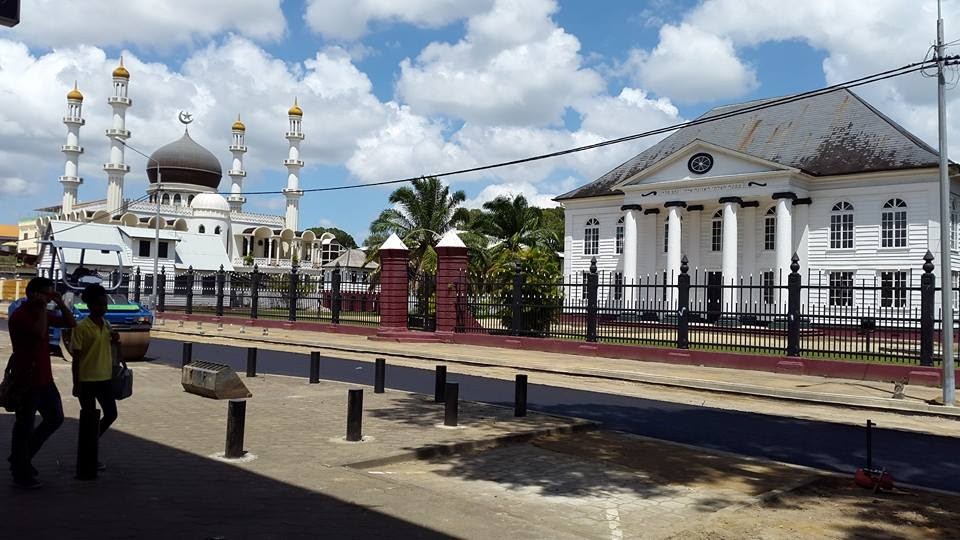
Paramaribo is known for a mosque and a synagogue sharing a parking lot for decades, with a Hindu temple just blocks away — a symbol of the country's religious tolerance.
Nature & Biodiversity
Over 93% of Suriname's territory is covered by pristine Amazon rainforest — one of the highest percentages of any country in the world. It is home to the Central Suriname Nature Reserve, a UNESCO World Heritage Site, and exceptional biodiversity: jaguars, tapirs, monkeys, hundreds of bird species, and one of the highest concentrations of biodiversity per square kilometer on the planet.
This makes Suriname a growing destination for ecotourism, scientific research, and sustainable development.
Political System & Stability
Suriname is a parliamentary democracy with regular elections. The country maintains active diplomatic relations and is a member of organizations such as CARICOM, the OAS, and the United Nations — providing an internationally recognized institutional framework.
Doing Business in Suriname
An Untapped Opportunity for Colombia
Although Suriname is a close geographic neighbor, it remains largely unknown in the Colombian business world. That represents an untapped opportunity: a market with less competition, an expanding economy — particularly in the oil sector — and a strategic gateway into the Caribbean and CARICOM.
Economy
An Economy in Transformation
Suriname is experiencing a historic moment thanks to recent offshore oil and gas discoveries, positioning the country as one of the region's most promising emerging markets.
Oil & Gas
Rapid development of offshore projects; events like SEOGS (Suriname Energy, Oil & Gas Summit) attract investment and international suppliers every year.
Mining
Gold and other minerals, backed by a long extractive tradition.
Agriculture & Agribusiness
Rice, bananas, and growing potential for value-added products.
Forestry
Sustainable use of the country's vast forest resources.
Construction & Infrastructure
Rising demand driven by oil-sector investment.
Tourism
Ecotourism and cultural tourism, still in early stages of development.
Investment Climate
A Market Open for Business
- Suriname has a legal framework open to foreign investment
- As a CARICOM member, it offers preferential access to Caribbean markets
- Dutch is the official language of business, but English is widely used in the business environment and international trade relations
- Paramaribo has a functioning banking system and maritime and air connections to the Caribbean, Europe, and South America
Landmark Offshore Development
GranMorgu — TotalEnergies
Suriname's energy transformation is anchored by GranMorgu, the country's first large-scale deep offshore oil project, operated by TotalEnergies together with APA Corporation and Staatsolie, Suriname's national oil company. The project will develop the Sapakara and Krabdagu oil fields in Block 58, located roughly 150 km off the Surinamese coast, with recoverable reserves estimated at close to 750 million barrels.
Total investment
~US$10.5B
First oil
Targeted 2028
Local content
US$1B–1.5B
FPSO capacity
220,000 bpd
Ownership: TotalEnergies (40%), APA Corporation (40%), and Staatsolie (20%). Hub effect: Paramaribo is being positioned as the administrative, logistics, and operations-support center for the project, drawing international suppliers in drilling, subsea services, pipe supply, and well construction to open local offices and service centers.
Recent Gas Discoveries
Petronas & Block 52
Alongside GranMorgu, Malaysia's Petronas has been steadily advancing Block 52, part of an offshore corridor industry watchers call the "Golden Lane." As of mid-2026, Petronas has recorded eight successful exploration and appraisal wells in Block 52, with combined recoverable resources estimated at over 1 billion barrels of oil equivalent.
The block's original Sloanea gas discovery has been declared commercially viable, and Petronas is expected to take a Final Investment Decision on a gas development before the end of 2026. The concept under consideration is a Floating LNG (FLNG) facility, liquefying gas at sea for export, with first gas targeted around 2030. Petronas also holds new production-sharing contracts in shallow-water Blocks 9 and 10, off the Saramacca coast, currently in early 3D seismic exploration.
Other majors are active across the basin too: Shell and QatarEnergy are preparing to drill in Block 65, and Chevron is conducting seismic and appraisal work in other blocks — signaling sustained international interest beyond a single operator.
The Window Is Now
What This Means for Colombian Companies
TotalEnergies' oil project moving into construction, and Petronas' gas discoveries approaching a final investment decision, mean Suriname's offshore sector is shifting from exploration to execution. This is the window in which supply chains, logistics contracts, and local service partnerships get built. Colombian companies in oil & gas services, logistics, construction, and marine support that position themselves now — before the market matures — stand to benefit most from the local content requirements and service contracts both projects are generating.
Why Suriname
A Strategic Opportunity for Colombian Companies
An Underserved Market
Very few Colombian companies know or have explored the Surinamese market, meaning less competition and greater room for early positioning.
Oil Boom
The offshore industry needs suppliers, logistics services, construction, food supply, and a broad supply chain — areas where Colombia has strong experience and export capacity.
Gateway to CARICOM
Establishing a presence or partnership in Suriname can facilitate access to other Caribbean markets.
Relative Proximity
Compared to other international markets, Suriname is closer to Colombia than many destinations Colombian companies already export to.
Challenges to Keep in Mind
Going in With Eyes Open
- Language barrier (Dutch/Sranan Tongo), which is exactly why having a trusted local partner is key
- A small market in size, but high in value given its stage of economic growth
- The need to understand local business culture and networks, often built on personal relationships
Learn More About Suriname
Explore these external resources to discover more about Suriname.
Our Role
The Suriname Colombia Business Chamber
We act as a trusted bridge between Colombian and Surinamese companies.
Direct connections to verified contacts in Suriname
Representation and support at trade fairs and business forums
Market reports and sector-specific opportunity analysis
Ongoing access to the binational business network