Discover Colombia
A Gateway Between Two Oceans
South America's most populous Spanish-speaking nation, and an increasingly important trade and investment gateway in the Western Hemisphere — introduced here for Surinamese businesses, investors, and professionals.
Geography & Location
A Rare Dual-Ocean Gateway
Colombia sits in the northwest corner of South America, bordered by Panama, Venezuela, Brazil, Peru, and Ecuador, with coastlines on both the Caribbean Sea and the Pacific Ocean — a rare dual-ocean access that supports both Atlantic and Pacific trade routes. With a total area of roughly 1.14 million square kilometers, it is one of the larger countries in Latin America, approximately twice the size of France.
The country's geography is exceptionally diverse, spanning the Andes mountain range, vast eastern plains (Llanos), Amazon rainforest, and long coastal regions. Given its equatorial location, climate is shaped more by altitude than by season — tropical along the coasts and Amazon basin, temperate in the Andean highlands where most major cities sit, with two general rainy periods around April–May and October–November.
Capital
Bogotá
Size
~1.14M km²
Highest peak
Pico Cristóbal Colón, 5,775m
Coastlines
Caribbean & Pacific
Demographics & Society
Latin America's Third Most Populous Nation
Population
Approximately 52–53 million inhabitants, making Colombia the third most populous country in Latin America after Brazil and Mexico.
Urban Centers
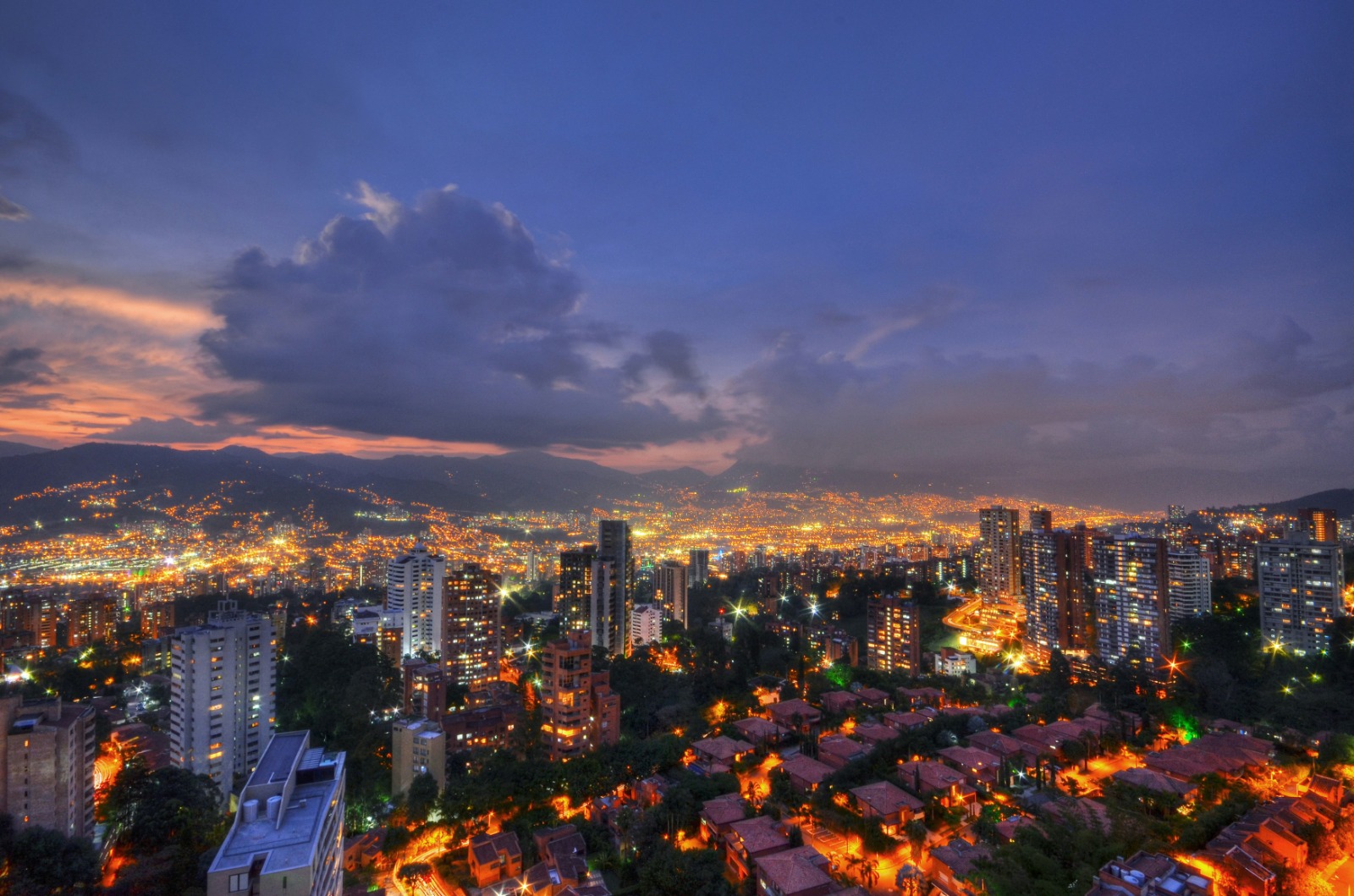
Concentrated in Bogotá (the capital, close to 8 million residents), Medellín — a hub for technology and innovation — Cali, and the Caribbean port cities of Barranquilla and Cartagena.
Ethnic Composition
A blend of Indigenous, European, and African heritage. Afro-Colombians make up roughly 7% of the population and Indigenous peoples around 4%, spread across more than 80 distinct groups.
Language & Religion
Spanish is the official and near-universal language, with growing English proficiency in business and outsourcing. The population is predominantly Christian, mostly Roman Catholic with a growing Protestant/Evangelical community.
Culture
Colombian culture varies markedly by region — Caribbean coastal culture (vallenato, cumbia) differs distinctly from Andean highland traditions and from Pacific Afro-Colombian culture. Colombia is globally recognized for its coffee culture, with the Coffee Cultural Landscape in the Andean coffee-growing region recognized as a UNESCO World Heritage Site.
The country also has a strong, internationally visible creative sector — music, television production, and literature, including the legacy of Nobel laureate Gabriel García Márquez — which increasingly intersects with its business process outsourcing and digital content industries.
Nature & Biodiversity
Colombia is the second most biodiverse country in the world after Brazil, and ranks first worldwide in bird species — a distinction that underpins a fast-growing ecotourism sector. Forests cover close to half of the national territory, including a substantial share of the Amazon rainforest, though deforestation driven by illegal mining and cattle ranching remains an active environmental challenge.
Green energy, sustainable agriculture, and the bioeconomy are explicit national priorities under Colombia's current development plan — creating openings for partners, including Surinamese companies with experience in tropical natural-resource sectors.
Political System
A Presidential Republic
Colombia is a presidential republic with a bicameral Congress (Senate and Chamber of Representatives) and independent executive, legislative, and judicial branches. The president is elected by popular vote for a four-year term, using a two-round system when no candidate wins a first-round majority.
Colombia held general elections in 2026. Following a first round on 31 May and a runoff on 21 June, right-of-center candidate Abelardo de la Espriella was declared the winner over Iván Cepeda, ending the term of outgoing President Gustavo Petro. The new administration is scheduled to take office on 7 August 2026 for the 2026–2030 term.
Despite periodic political volatility, Colombia maintains well-established democratic institutions, regular and transparent elections, and consistent legal protections for foreign investors — supporting its long-standing reputation as one of the more predictable jurisdictions in Latin America for international business.
Chamber note: given the change of administration in August 2026, Colombia's foreign trade and investment priorities may be refined in the months following the transition. The Chamber will monitor and update this section as the new government's policy direction becomes clearer.
Doing Business in Colombia
A Practical Guide for Surinamese Companies
This section outlines the practical business environment in Colombia for Surinamese companies considering market entry, partnerships, or investment, and summarizes the current state of Suriname–Colombia trade as a baseline for growth.
Economic Snapshot
Latin America's Fourth-Largest Economy
Growth is supported by private consumption, investment, and relatively stable macroeconomic conditions. Bogotá is the undisputed financial hub, hosting the bulk of national and multinational banks, insurers, and fintech companies.
Nominal GDP (2026)
~US$540B
Projected growth
2.3%–2.8%
Services share of GDP
60%+
Exchange rate (mid-2026)
~COP 3,250 / USD
Key Sectors
Where Foreign Investment Is Flowing
Energy & Natural Resources
Oil, natural gas, coal, and hydropower remain central to the economy, alongside a growing government push into renewable energy — directly relevant given Suriname's own emerging offshore sector.
Mining
Rich in gold, emeralds, nickel, and copper; mining continues to attract significant foreign direct investment.
Agribusiness
Coffee, flowers, bananas, and other agricultural exports remain a traditional strength — a natural point of connection for Surinamese agricultural and food-sector companies.
Technology, Fintech & BPO
Bogotá and Medellín are recognized regional hubs for IT services, fintech, and business process outsourcing, drawing significant foreign direct investment.
Infrastructure & Logistics
Ongoing government investment in transport, ports, and telecommunications is improving connectivity for logistics, construction, and engineering partners.
Financial Services & Manufacturing
A well-developed banking sector and diversified manufacturing base, alongside a growing tourism industry built on biodiversity and cultural heritage.
Foreign Investment Climate
Setting Up in Colombia
Suriname–Colombia Trade
A Modest but Fast-Growing Baseline
Trade between Suriname and Colombia is currently modest but growing steadily, which the Chamber views as a strong argument for structured facilitation rather than a sign of limited opportunity. Colombia's exports to Suriname grew at an annualized rate of nearly 22% over five years; Suriname's exports to Colombia, while smaller, have grown even faster in relative terms.
Colombia → Suriname (2023)
US$24.9M
Colombia → Suriname (2018)
US$9.25M
Suriname → Colombia (2023)
US$1.85M
Suriname → Colombia (2018)
US$170K
What Colombia sells to Suriname: construction materials such as quicklime and cement, electrical transformers, and other mineral and industrial products. What Suriname sells to Colombia: currently led by medical instruments, along with smaller volumes of other manufactured and recovered-material goods.
Suriname is one of only three South American countries — alongside Colombia and Ecuador — for which the United States remains the principal trading partner. Diplomatic relations between the two countries date to 1978, and both are members of CELAC, the OAS, and UNASUR, with Suriname additionally an associate state of Mercosur. There is currently no direct Colombia–CARICOM trade agreement covering Suriname, which reinforces the value of a dedicated bilateral chamber to build commercial ties outside formal trade-bloc arrangements.
Opportunities
For Surinamese Companies
Energy Sector Partnerships
Colombian oilfield services, engineering and energy-sector suppliers are well positioned to support Suriname's offshore buildout (GranMorgu, Block 52), while Surinamese companies can offer local market access and logistics knowledge in return.
Agro-Industrial Trade
Both countries have agro-industrial export strengths; targeted product-level matching, rather than broad sectoral outreach, is likely to yield the most concrete near-term deals.
Logistics & Connectivity
Growth in trade volumes to date has been driven largely by industrial and construction materials moving from Colombia to Suriname; formalizing shipping, customs and logistics arrangements could meaningfully lower costs and accelerate this trend.
First-Mover Positioning
Given the still-modest baseline trade volumes, Surinamese companies that establish relationships now stand to secure early, durable positioning as bilateral trade continues its double-digit growth trajectory.